
Where Does Creativity Come From?
Does it come from talent? Imagination? Experience? Curiosity?
Maybe it begins with a simple origin: Our desire to make meaning from the world around us.
As a child, you made a mark with a crayon to see what happened. You didn’t wonder if your drawing was good or worthy. You were curious and it felt good to color. It was freeing to create without asking someone, “Is this good?”
Somewhere along the way of growing older we lost that freedom to express for the sake of expressing. We began asking “Am I good enough?” “What will people think?” “Is this worth making?”
But your creativity didn’t disappear. It is still there, waiting to be noticed.
What if…?
I wonder…
What would happen if…?
Could I…?
Curiosity encourages us to explore rather than simply accept things as they are. Creative people don’t have all the answers, but they’re often people who are willing to follow their questions. Creators tend to be scientists and scientists tend to be creators.
If you could pursue three ideas you’re curious about, what would they be?
Imagination allows us to see something that doesn’t exist yet.
Before a painting exists, someone imagined it.
Before a story is written, someone imagined a character.
Before a new invention exists, someone imagined a possibility.
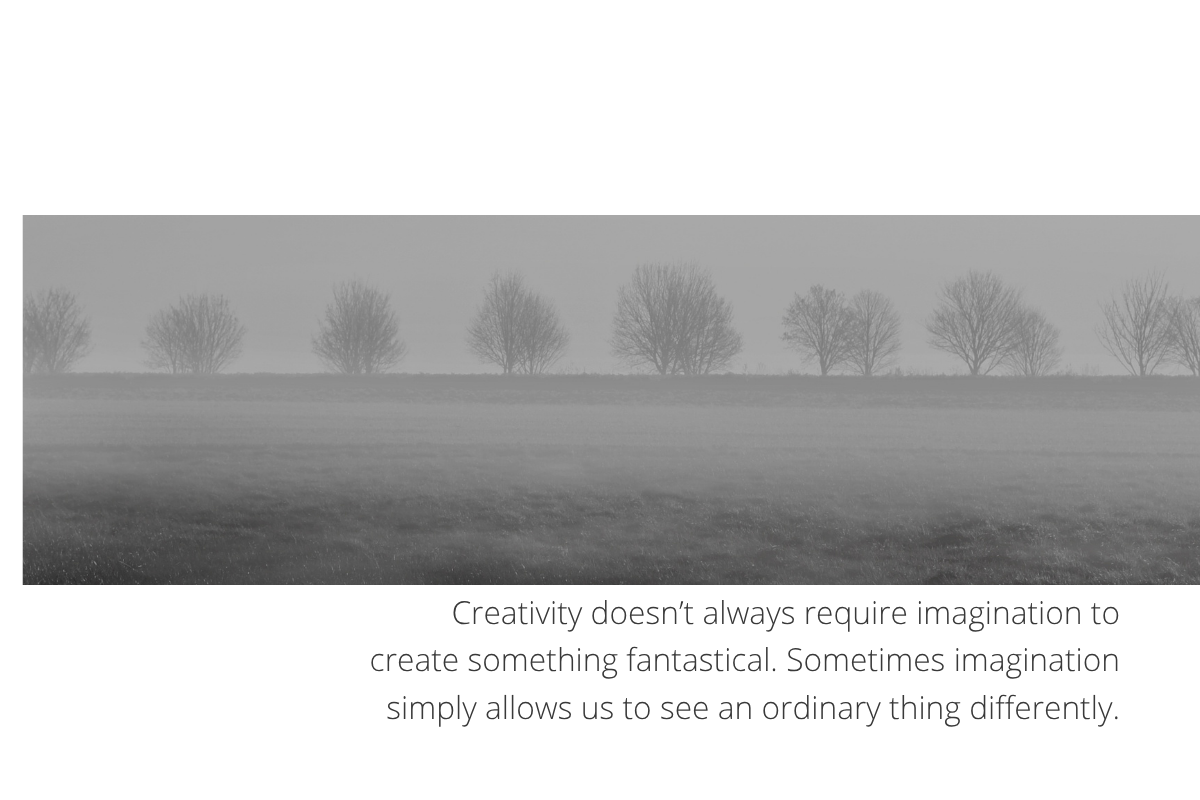
A tree becomes a shape. Shadows morph into a pattern. A comment overheard in a passing moment is the beginning of a story. A memory becomes a painting.
Sometimes we create because we have something inside us that wants somewhere to go.
Joy - Grief - Sorrow - Anger - Love - Fear - Longing - Wonder - Peace
Creativity gives our emotions a language.
We may not know the words to explain what we are feeling, but we might know what color it needs to be. We might not know how to describe sadness, but we might know how it moves across a page. We might not have words for something we’ve experienced but we can make something that helps us understand it.
Emotion can become expression.
What you feel doesn’t have to remain trapped inside you. It can become color, movement, words, texture, music, photography, collage, dance, or another form of expression.
Everything we’ve experienced becomes part of the creative portfolio we carry.
places we’ve lived
people we’ve loved
things we’ve lost
books we’ve read
music we’ve heard
conversations we’ve had
things we’ve noticed
moments we’ve forgotten
Even experiences we don’t consciously think about can influence what we create.
Creativity is a personal collection of fragments of life. We gather little pieces throughout our lives, and sometimes creativity brings those pieces together in ways wew didn’t expect.
Creativity isn’t always about making. Sometimes it begins with noticing.
Notice the movement of leaves in the canopy, the bold combinations of colors in the cereal aisle, the splattering sound of rain, the shape of someone’s smile, how you feel in a new setting.
Awareness is creative fuel.
Children experiment, scribble, build, pretend, make up stories, mix colors, turn boxes into houses, play with their food, dance in the kitchen, ask endless questions.
Their creativity isn’t necessarily stronger than ours. Their relationship with creativity is simply less restricted.
Maybe becoming more creative isn’t about learning how to create. Maybe it’s partly about remembering how to explore without needing everything to be perfect.
As we grow up (maybe even during childhood), we are encouraged by some people, but we are also discouraged by others.
“That’s not good.”
“Stay within the lines.”
“You’re not imaginative enough.”
“That’s weird.”
“You should do something worthy of your time.”
“That’s not the norm.”
Overtime we internalize those messages. We dread the judgment of others. We compare ourselves. We strive for perfectionism. We stop experimenting. We wait because we’re not good enough right now.
The loss of creative confidence isn’t the same thing as the loss of creativity.
Sometimes the first step toward becoming more creative isn’t learning a new technique. It’s giving yourself permission to make something without needing it to become anything.
Repeat.
I give myself permission to create.
... to make something imperfect.
... to experiment.
... to change my mind.
... to create something nobody understands.
... to make something no one else sees.
... to be a beginner.
... to create simply because I want to.
Creativity connects:
thought to emotion
experience to expression
observation to imagination
memory to meaning
curiosity to exploration
inner world to outer world
YOU to THE WORLD AROUND YOU
Creativity is one of the ways we connect our inner world with the world around us. We take something we’ve noticed, felt, imagined, or experienced and give it form.
Maybe it comes from curiosity, imagination, emotion, memory, experience, awareness, asking questions, noticing something beautiful, wanting to understand something, or from having something inside us that wants to be expressed.
Maybe creativity doesn’t come from one particular place inside us.
Maybe creativity comes from being human.
And maybe the creative part of you has been there all along. You don’t have to become someone creative. You only have to begin listening to the creativity that’s already within you.
Creative You Journal Activity
In your journal, take 10 minutes and finish these statements. My creativity comes from ...
something I’m curious about...
A memory I carry...
An emotion I’m feeling...
Something I’ve noticed recently...
Something that inspires me...
Something I’m imagining...
Something I want to understand...
Something I want to express...
Something I would create if I wasn’t afraid of judgment...
Something I feel burning inside me...
What wants to be created through you?